Every kit and every load packed right the first time.
In kitting centres, aftermarket operations and logistics services, the operator decides whether an order leaves complete and correctly packed. Arkite shows the right bin, the right position and the right pattern, checks every pick and placement, and records the result per order.
What we hear from kitting and logistics teams.
One wrong part in a kit means a complaint, a return and a second shipment.
Picking errors
Every operator packs the handling unit differently, so fill rates vary per shift.
Inconsistent packing
Only a small, experienced team knows the packing rules for our critical shipments.
Knowledge with a few people
Hundreds of box formats and changing orders make paper pick lists outdated fast.
Growing variety
Four challenges in kitting and packing, and what changes with Arkite.
 01
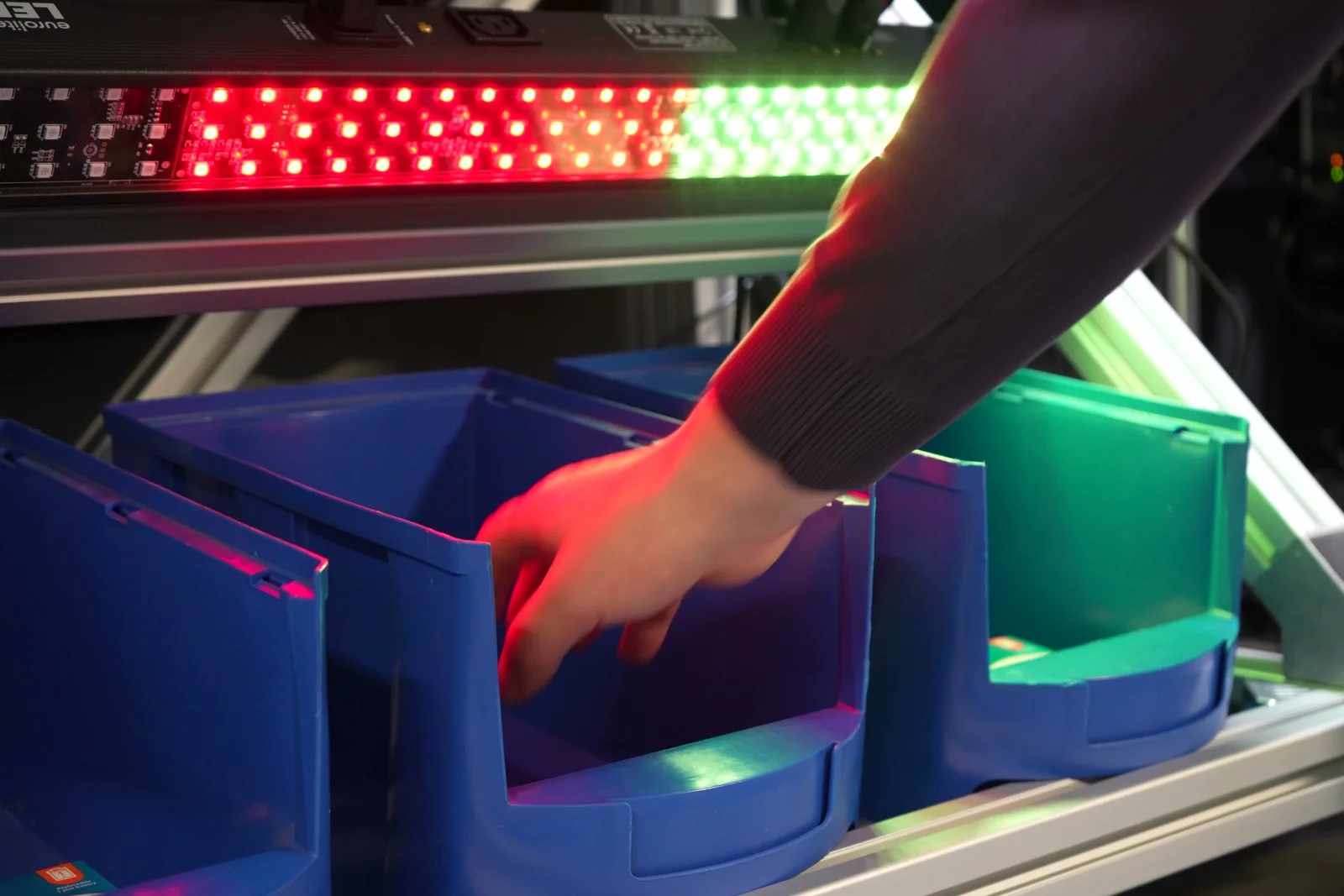
The right part in every kit, checked at the pick.
- Today
- Similar parts and frequent order changes lead to wrong or missing items in the kit.
- With Arkite
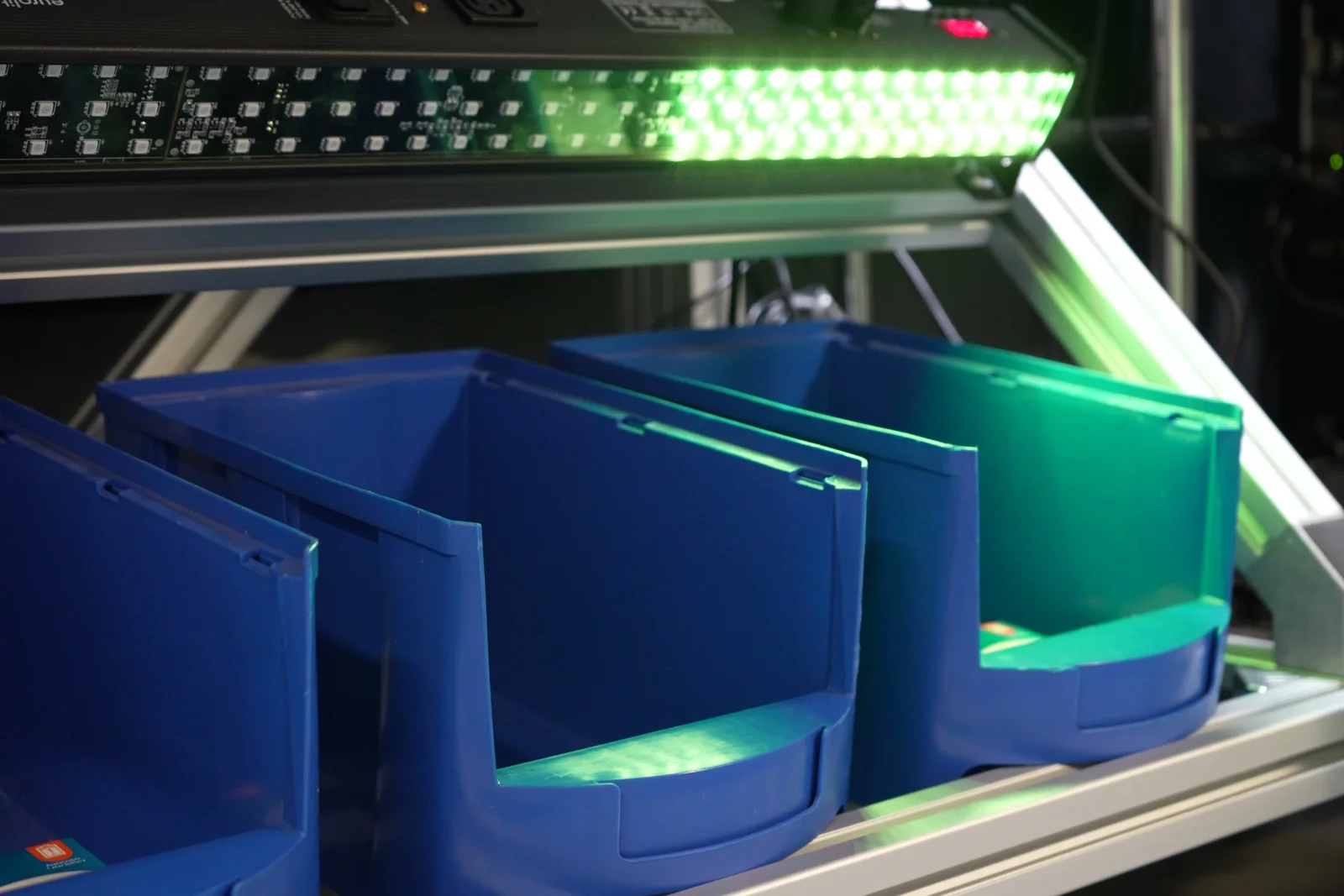
- Projection or DMX lights show the bin and the quantity. The 3D sensor checks every pick, and a wrong bin gives an immediate warning before the part reaches the kit.
 02
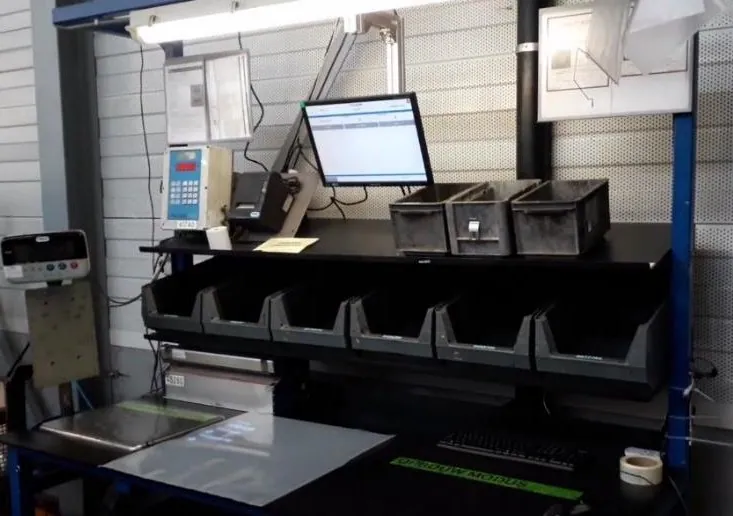
Every box in the position your packing logic calculates.
- Today
- Without a plan for the full order, each operator fills the handling unit in their own way.
- With Arkite
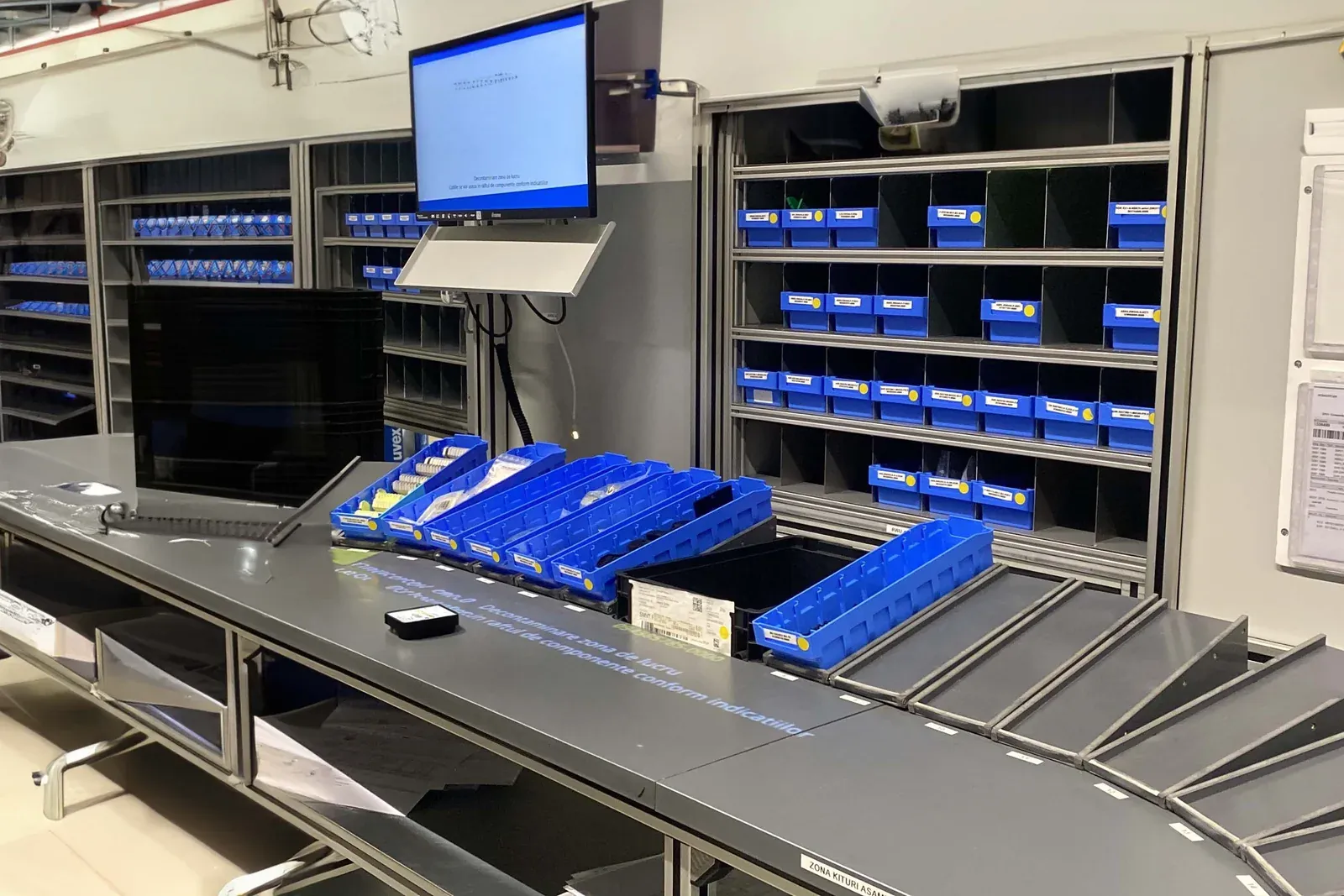
- An external packing algorithm sends the coordinates of each box. Arkite projects the next position in the handling unit and validates the placement before the next box.
 03
Loading patterns projected, layer by layer.
- Today
- Critical shipments follow strict loading patterns that only a fixed team knows by heart.
- With Arkite
- The pattern for the product and volume is stored once. Arkite projects where each box goes and which material to use per layer, so every operator packs to the same standard.
 04
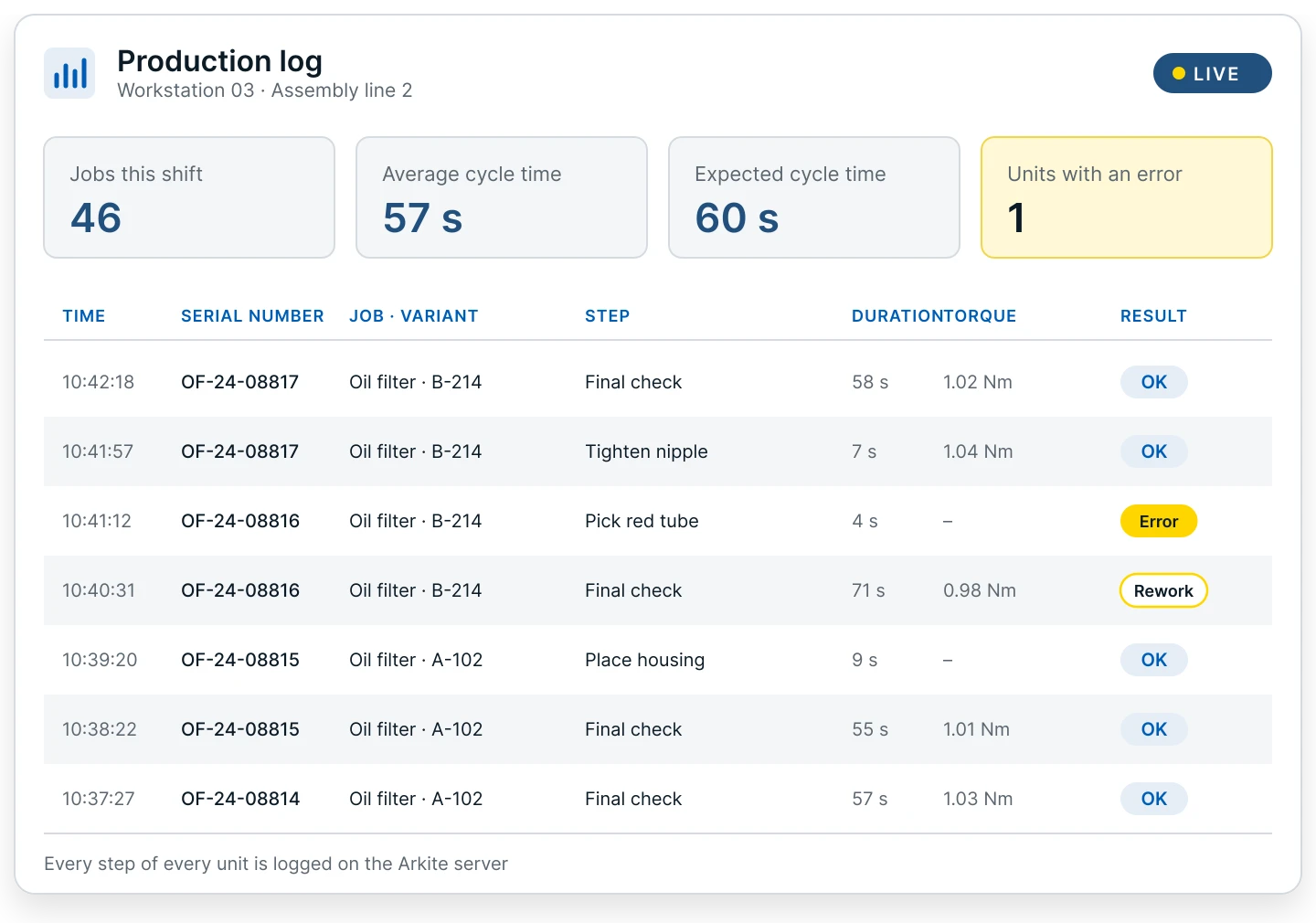
Every pick and placement recorded per order.
- Today
- When a customer reports a wrong or incomplete delivery, there is no record of what happened at the station.
- With Arkite
- Arkite logs each step with time, result and operator context per order or handling unit. Data goes to your WMS, ERP or BI tools through the database, CSV export or the API.
The topics that matter, and what Arkite does for each.
- Kitting
Components for one order or assembly are collected in a kit. Arkite guides each pick and validates it, so the kit is complete before it leaves the station.
- Pick and place
The operator takes an item from a source bin and places it in a target position. Arkite projects both and checks the placement with the 3D sensor.
- Handling unitHU
The package or pallet that leaves the station. Arkite follows the packing order per handling unit and records what was placed where.
- Fill rate
How well the volume of a handling unit is used. Guided placement from a packing algorithm keeps the fill pattern the same for every operator.
- Order traceability
Every pick, placement and label is logged per order, so a complaint can be traced back to the station and the moment.
Kitting and packing with Arkite at Schaeffler and H.Essers.
In its aftermarket kitting operations, Schaeffler composes kits from a wide range of box formats, labels them and places them in handling units. Pilot stations were equipped with a projector and a 3D sensor. Schaeffler's own packing algorithm calculates the position of each box, Arkite receives those coordinates, projects the next position and validates the placement in real time. The result was more accurate packing, more consistent fill rates, faster onboarding of new operators and a record of every action.
H.Essers uses Arkite for temperature-critical pharma air freight. The loading pattern and the gel type for every layer are projected, so a wider team can pack insulated shipments to the same standard as its most experienced operators.
Logistics and kitting operations running Arkite.

What Arkite did for them
Where logistics and kitting teams use Arkite
Picking and kitting
Projection or DMX lights with 3D validation of every pick, also for large and stacked bin areas.
Packaging
Packing instructions per order, placement guidance and labels printed at the station.
Traceability
Every pick and placement logged per order or handling unit.
Integrations
Orders and bin content from your WMS or ERP, results back through the API.
Questions from logistics teams
Can Arkite use the result of our own packing or loading algorithm?
Yes. An external system can send the positions of the items to Arkite through the API. Arkite projects the next position at the station and validates the placement before the next item.
Does Arkite work with large racks and stacked bins?
Yes. Where projection cannot reach every bin, DMX lights indicate the location. For stacked bins, virtual detection zones at the bin entrance let the 3D sensor validate each pick.
Where do the orders come from?
Orders can be scanned at the station, created in Arkite or received from a WMS, ERP or MES. Arkite loads the matching job and shows only the steps for that order.
Discuss your kitting or packing station
Bring an order with many parts or a packing pattern that is hard to keep consistent. We will show how Arkite would guide, check and record it.
- A specialist replies to you personally
- We look at your process, products and systems
- Together we define a first pilot workstation