High-mix assembly puts pressure on the workstation in a very specific way. The line is expected to stay flexible, operators need to switch between variants without hesitation, and process engineers need to keep quality stable even when product complexity rises. On paper, that sounds manageable. On the floor, it often turns into small execution gaps that add up quickly: the wrong component bin is used, an experienced operator resumes at the wrong step after a break, a late engineering update does not reach every station in time, or a changeover relies too heavily on tribal knowledge.
This is why changeovers deserve more attention than they usually get. In many factories, the changeover itself is treated as a scheduling or logistics event. In reality, it is also an execution risk. The moment a new variant enters the station, the operator has to absorb product-specific instructions, sequence rules, quality checks, and tool requirements without losing pace. If that information is fragmented across paper SOPs, static screens, memory, and supervisor support, consistency suffers.
Arkite approaches this differently. Instead of adding more supervision around the workstation, the platform creates a digital standard at the point of execution. ERP decides what. MES decides when. Arkite tells operators how. For high-mix environments, that matters because the challenge is not only choosing the next order correctly. The challenge is making sure the right action happens, in the right place, for the right variant, with the right level of guidance.
Why high-mix assembly becomes unstable during changeovers
High-mix production is valuable because it gives manufacturers flexibility. It also creates daily pressure on standardization. The more variants, product options, customer-specific configurations, and engineering updates a line has to handle, the harder it becomes to keep work stable at station level.
That instability usually does not come from one dramatic failure. It comes from many small moments of uncertainty.
An operator arrives at a station after a product switch and has to confirm which variant is active. A temporary worker knows the product family but not the latest configuration detail. A process engineer updates a step, but one printed instruction sheet stays in circulation longer than it should. A supervisor is pulled away to solve another issue, so the operator continues based on habit. None of these moments look serious on their own. Together, they create rework, missed steps, interruptions, and uneven execution across shifts.
This is particularly common in manual assembly environments where complexity is concentrated at the workstation. PCB assembly, mixed-model sub-assembly, cabling and wiring, kitting, and configurable industrial products all share the same pattern: operators do not just repeat one fixed cycle. They move through a process that changes according to the product being built.
In those environments, standard work cannot depend on memory alone. It has to be delivered in a way that matches the reality of the line: multiple variants, multiple operator experience levels, and a constant need to keep throughput moving.
Why paper and static instructions break down when variants change
Traditional work instructions were not designed for the pace of modern high-mix production. They can document a process, but they struggle to manage variation at the moment execution happens.
Paper instructions, static PDFs, and generic workstation screens all have the same core weakness. They tell the operator what the process should be, but they do not actively adapt to the product, the station state, or the operator’s next action. That creates friction as soon as a changeover happens.
In practice, this means operators often spend valuable time translating instructions into action. They check the variant, compare part numbers, verify the sequence, ask for confirmation, and mentally filter what applies to the current build. Even highly capable operators lose time this way. More importantly, the risk of inconsistency increases exactly when the line needs clarity.
That is why digital work instructions matter more in high-mix assembly than in low-variation production. The objective is not simply to replace paper. It is to create an execution layer that keeps the workstation aligned with the live production context. Arkite’s existing article on Digital Work Instructions in Manufacturing: From Paper SOPs to Guided Assembly is a useful foundation here, but the high-mix question goes one step further: how do you maintain that digital standard when the line keeps changing?
How Arkite creates a digital standard at the workstation
Arkite’s strength in high-mix assembly is that it turns the workstation into an active part of the production system. The platform does not just display instructions. It structures execution.
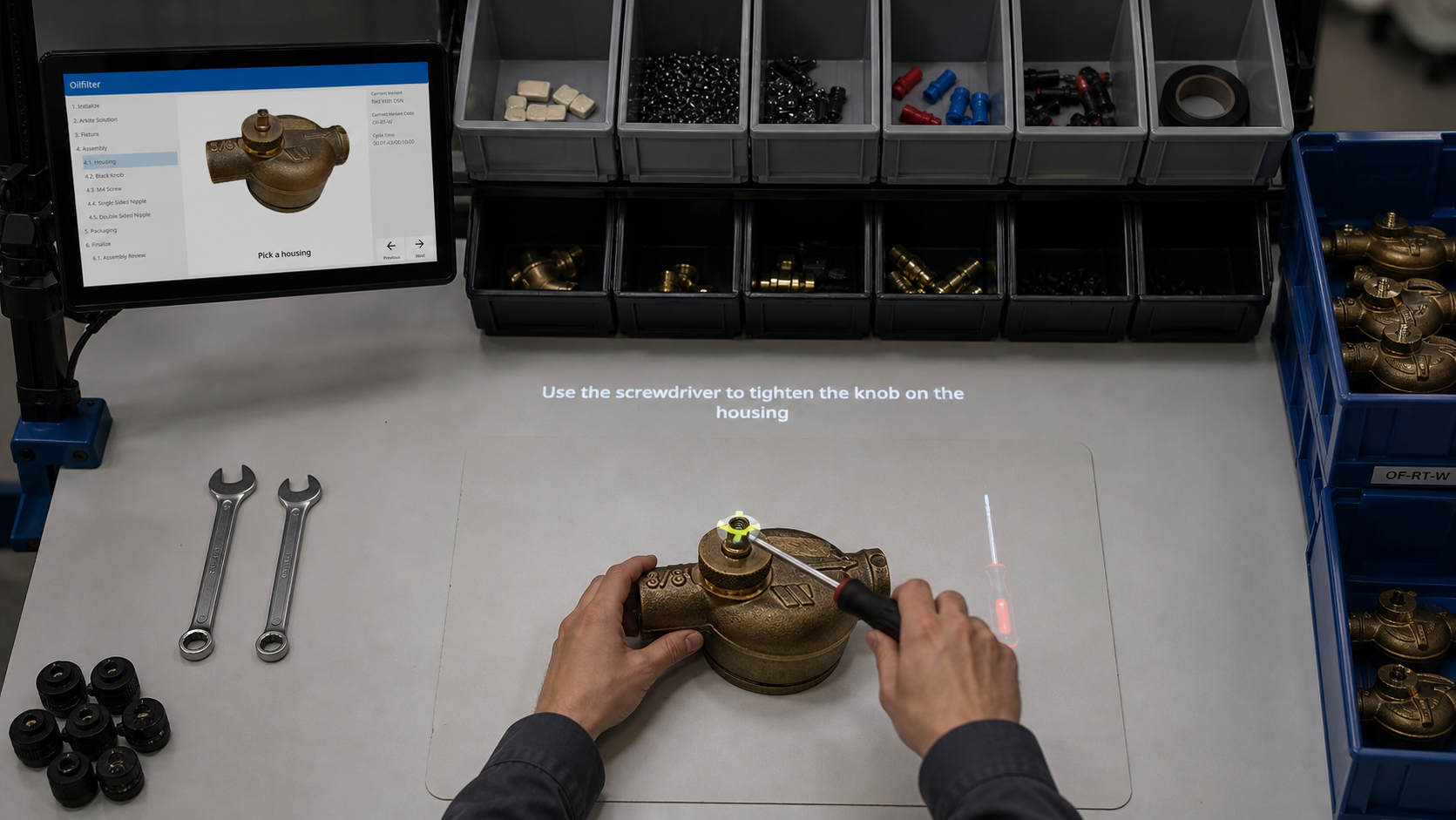
At the most practical level, that starts with variant-aware operator guidance. The workstation can load the right workflow for the active product and guide the operator step by step. Instead of asking the operator to interpret a broad instruction set, the system presents the relevant step, in the relevant sequence, for the variant currently being built. That reduces cognitive load and keeps the operator focused on execution rather than navigation.
The second layer is validation. In high-mix assembly, knowing what to do is only part of the challenge. The other part is making sure the correct action has actually happened before the process continues. Arkite VALIDATE adds real-time confirmation at station level, helping manufacturers reduce the risk that the wrong component, wrong sequence, or wrong workstation action slips through during a busy changeover.
The third layer is adaptability. High-mix assembly lines rarely serve one type of operator. Some people are highly experienced. Others are new, cross-trained, or temporarily assigned. Arkite can adjust guidance according to operator experience level, which matters because standardization should not mean slowing down experts to the pace of novices. It should mean creating a shared digital standard that stays usable for both.
This is an important distinction. Many manufacturers hesitate to add more guidance because they fear it will over-control the workstation. In reality, the problem is usually the opposite. Without a strong digital standard, experienced operators are forced to compensate for gaps in process delivery, while newer operators depend too heavily on informal support. A well-structured execution layer removes that instability.
What this looks like during a real changeover
Consider a mixed-model sub-assembly station where two similar product variants share most of the same process but differ in component selection, fastening sequence, and one quality checkpoint.
In a conventional setup, the operator may need to confirm the variant on a paper traveler, scan a work instruction sheet, locate the correct bins, remember which step changes for that version, and double-check whether the torque setting has been updated. If the station is busy, or if the previous job looked similar, it is easy to carry the wrong assumption into the next build.
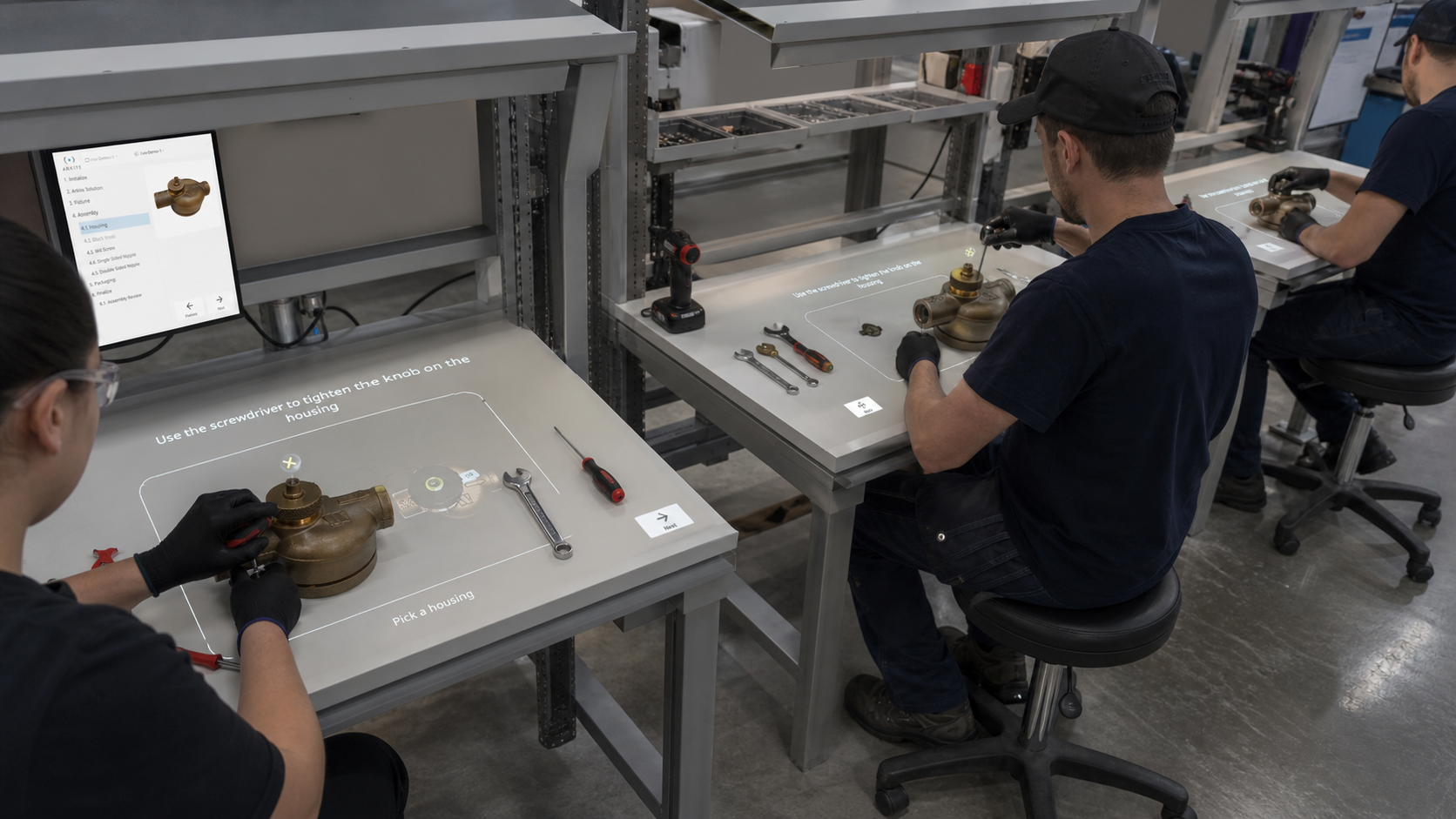
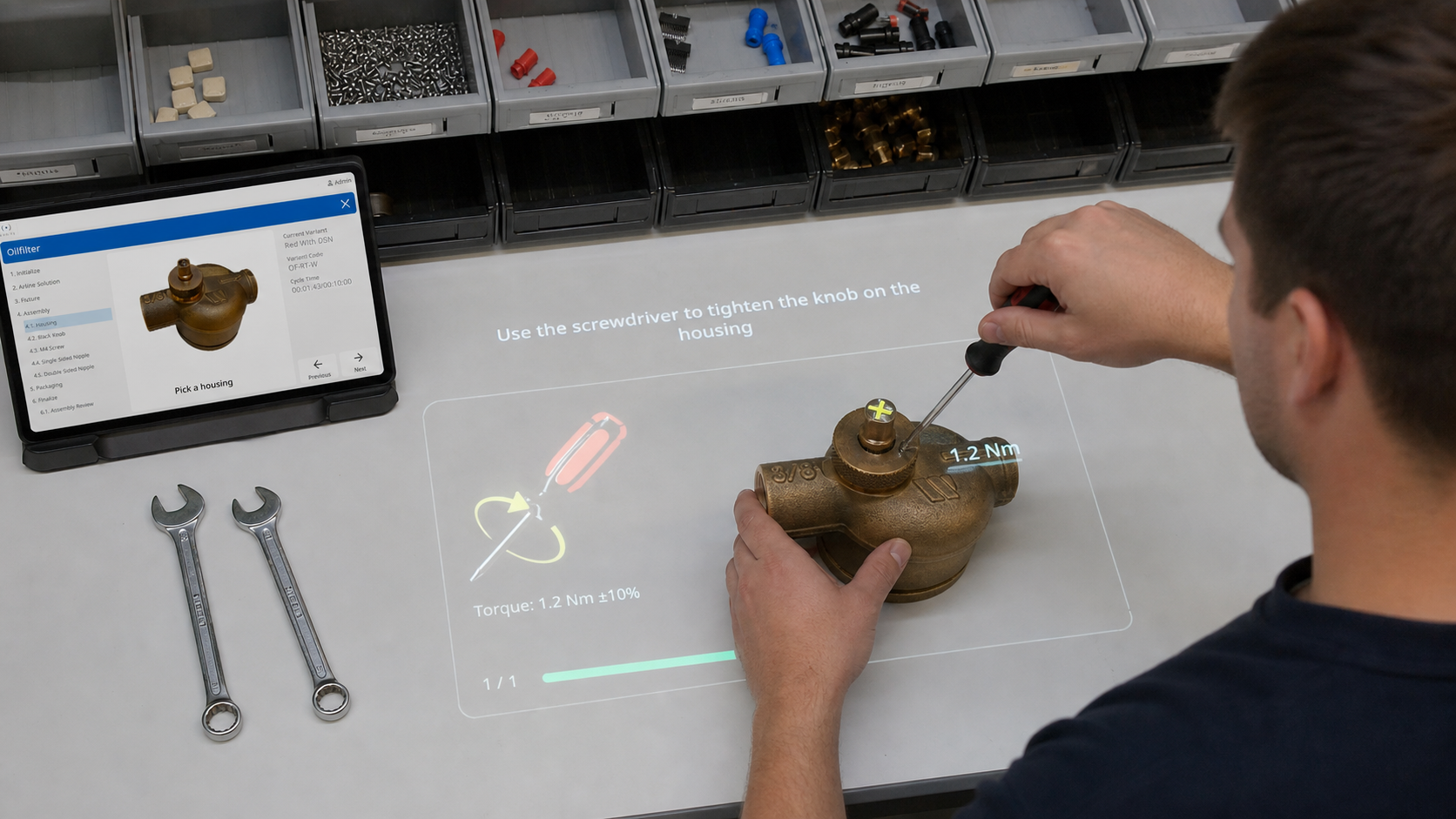
With a workstation-centric digital standard, the changeover becomes much more controlled. The active order or variant can trigger the right workflow. The operator sees the next required action directly at the station. The correct bin or assembly location is highlighted. Tool behavior can be linked to the active step. Validation confirms the action before the process moves on.
The result is not only fewer mistakes. The result is fewer micro-decisions that operators should not have to make under time pressure.
This is especially relevant in scenarios Arkite materials already point to, such as electronics assembly, picking and kitting, wiring, and tightening operations. In a PCB assembly context, for example, a small sequence error or missed placement step can lead to rework that is disproportionate to the time it took to create the mistake. In a wiring or sub-assembly context, a product family may share most of its structure while still requiring variant-specific routing, fastening, or inspection logic. Changeovers in those environments need more than documentation. They need live execution support.
A second example is the return from interruption. Arkite’s ROI material highlights a realistic shop-floor issue: operators returning from a lunch break and restarting at the wrong point in the process. That kind of error is common in high-mix environments because continuity depends on memory. A digital execution layer restores context immediately. The operator does not need to reconstruct where the process was. The workstation already knows.
How to standardize changeovers without slowing the line down
One reason some manufacturers tolerate unstable changeovers is that they assume stronger control will reduce flexibility. In practice, the opposite is often true. When the workstation provides the right guidance at the right moment, operators spend less time searching, asking, checking, or recovering from avoidable deviations.
For process engineering, this changes the role of standardization. Instead of creating one static document that tries to cover every possibility, the team can define a digital standard that adapts by variant, supports versioning, and can be updated centrally. That is a much better fit for high-mix production, where process changes are frequent and consistency matters across shifts, lines, and sites.
A practical rollout usually starts small. One product family, one workstation type, or one recurring changeover pain point is often enough to prove the concept. The goal is not to digitize everything at once. The goal is to stabilize one execution environment where complexity is already visible and costly.
From there, the model can expand. The same logic that helps one line manage product variants can support broader standardization across multiple stations. This is where Arkite’s position as a platform matters. The digital standard is not trapped inside one isolated workstation. It can connect to the broader production environment, integrate with business systems and tooling, and support multi-site consistency without forcing every operator into the same rigid interaction pattern.
That is also why Arkite’s positioning as the execution layer is useful in high-mix discussions. The ERP and MES layer remain essential, but they do not solve the final execution challenge on their own. They can determine what needs to be produced and when. They do not remove uncertainty from the operator’s next manual action. That is the gap the workstation layer has to close.
What operations leaders gain from a more stable changeover process
For operations leaders, the most important outcome is not a more impressive workstation. It is a more reliable line.
When changeovers are better standardized, several improvements tend to follow at once. Quality becomes more consistent because variant-specific risks are managed closer to the moment of execution. Training becomes smoother because new or reassigned operators can work inside a clearer structure. Process changes become easier to deploy because instructions are updated centrally rather than redistributed manually. Supervisors spend less time firefighting small execution problems that should have been prevented at station level.
Just as importantly, the line becomes easier to scale. High-mix production often grows in complexity faster than support structures do. A few experienced operators can keep things moving for a while, but that is not a durable operating model. If consistent execution depends too heavily on individual memory, then every staffing change, every new variant, and every rushed shift handover increases operational risk.
A digital standard reduces that dependence. It creates a more stable way to absorb complexity without pretending complexity will disappear.
Conclusione
Manufacturers do not need slower changeovers. They need more reliable ones.
In high-mix assembly, the challenge is not only managing product flow. It is maintaining execution quality when the workstation keeps changing. Paper instructions and static processes rarely hold up well under that pressure. Operators are left to bridge the gap, and the result is usually variation, interruption, and hidden rework.
Arkite addresses that challenge by creating a digital standard directly at the workstation. With operator guidance, validation, and production intelligence working together, manufacturers can support flexible production without losing control of execution. The result is a calmer changeover process, a clearer experience for operators, and a more scalable foundation for process engineering.
If your line is dealing with frequent variant changes, recurring restart errors, or inconsistent execution across shifts, it may be worth starting with one workstation and one product family. That is often where the value of a workstation-centric execution layer becomes easiest to see.