Trends for Operator Guidance in 2026
Manual work has not disappeared from manufacturing. Despite decades of automation, a large share of assembly, kitting, wiring, inspection and packaging still depends on people at workstations. What has changed is the environment around them. Labor markets, product portfolios, supply chains, quality requirements and the technology available to support operators have all shifted, and 2026 is the year many manufacturers are rethinking how manual operations are run.
This article looks at the trends reshaping manual manufacturing, the options manufacturers have to respond, and why an operator guidance platform such as Arkite is the strongest foundation for the years ahead.
Part 1: The trends reshaping manual manufacturing
1. The skills gap has become structural
Finding and keeping skilled operators is no longer a temporary problem that the next economic cycle will solve. Experienced people are retiring and taking undocumented process knowledge with them. New hires often come from other sectors, stay for shorter periods or work through agencies. Many plants now run multilingual teams on the same line.
The consequence is that manufacturers can no longer rely on experience as their main quality safeguard. Knowledge has to live in the process itself, not only in the heads of the best operators, and new people must become productive at the real workstation, not after weeks of side-by-side training.
2. High-mix, low-volume is the new normal
Customers expect configurable products and shorter delivery times. As a result, product variety keeps growing across automotive, electronics, industrial equipment, aerospace and medical devices, while batch sizes shrink, sometimes to one. Lines that once built a handful of products now handle dozens or hundreds of configurations.
For operators, this means constant switching between sequences that look similar but are not the same. That is exactly where wrong parts, skipped steps and incorrect torque values occur. Variant complexity has become one of the main drivers of errors in manual production.
3. Regionalized supply chains mean more plants to ramp up
Disruptions of recent years have pushed many manufacturers to bring production closer to their markets through reshoring, nearshoring and multi-sourcing strategies. New and expanded plants have to reach stable quality quickly, often with a workforce that has never built the product before.
This raises a new requirement: processes must be transferable. A manufacturer wants the same standard work, the same quality checks and the same data structure in every plant, without rebuilding everything locally.
4. Traceability and quality requirements keep rising
Customers, auditors and regulators increasingly expect proof of how each unit was built: which parts, which tool settings, which operator, which result. In regulated and safety-critical industries this has long been standard. It is now spreading to general industry as product documentation and sustainability reporting requirements grow.
Manual workstations are often the weakest link in that chain. Machines log their data automatically, while manual steps are recorded on paper, signed off afterward or not recorded at all.
5. Human-centric manufacturing
The idea that every manual task will eventually be automated has given way to a more balanced view. Automation pays off for high-volume, repetitive and well-defined tasks. People remain the most flexible resource for variant-rich assembly, small series, rework and changeovers. Concepts such as Industry 5.0 put the operator back at the center, with attention to ergonomics, cognitive load and job quality.
The question is no longer whether to automate or to rely on people, but how to give people the same level of support, control and data that automated cells already have.
6. AI arrives on the shop floor
Artificial intelligence has moved from presentations to practical use. In manual operations, the most valuable applications are concrete: drafting work instructions faster, translating them for multilingual teams and detecting product features that rule-based inspection struggles with. At the same time, manufacturers are cautious about data leaving the plant and about who is responsible for an instruction an AI has written.
7. From point solutions to platforms
Many plants have collected a patchwork of tools over the years: a document system here, a pick-to-light rack there, a camera check at end of line, a spreadsheet for training records. Each solved a local problem. Together they create integration effort, maintenance work and data that cannot be combined.
IT and OT teams are now much more involved in technology choices. They look for systems that scale across lines and plants, connect to MES, ERP and PLCs through open standards, keep data under the manufacturer's control and can be supported for years. The market is moving from isolated tools toward platforms.
Part 2: The options manufacturers have
Manufacturers respond to these trends in different ways. Each approach has its place, but they differ strongly in how much of the challenge they actually address.
Paper instructions and PDFs
Still common, cheap to start and familiar to everyone. But paper cannot keep up with frequent changes or many variants, versions drift between workstations, and there is no feedback on whether a step was performed correctly. Paper produces no usable data.
Screen-based digital work instructions
Instructions on a monitor or tablet are a clear step forward: content is managed centrally and can include images and video. The limitation is that the operator has to look away from the work to a screen, and the system typically relies on the operator confirming a step with a button or a pedal. It shows what to do, but it does not see whether it was done.
Pick-to-light and similar systems
Lights on bins indicate which part to take. This works well for picking, but covers only one part of the process. A confirmation button tells the system that someone pressed it, not that the correct part was taken and placed correctly. Assembly steps, tool use and product inspection remain outside its scope.
Wearable AR glasses
Head-mounted displays bring information into the operator's field of view and attract a lot of attention. In daily production, manufacturers run into practical questions: comfort over a full shift, battery life, hygiene when devices are shared, fit with safety glasses and the effort to manage a fleet of devices. For many plants these have kept wearables in the pilot phase.
Standalone vision inspection
Camera systems check the product, often at the end of a line or a process step. They detect errors, but only after they have been made, and they do not guide the operator toward doing it right the first time. Each new product or variant usually means new configuration work by a specialist.
An operator guidance platform
The most complete approach combines guidance, validation, inspection, integration and data in one system at the workstation. Instead of adding another tool, it adds an execution layer for manual work to the digital manufacturing stack.
| Requirement | Paper | Screen-based instructions | Pick-to-light | AR glasses | Vision only | Arkite |
|---|---|---|---|---|---|---|
| Guidance in the work area, hands free | No | No | Picking only | Yes, with a device | No | Yes, projected |
| Real-time validation of operator actions | No | Manual confirmation | Button confirmation | Limited | No | Yes, 3D sensing |
| In-process product inspection | No | No | No | No | Yes | Yes |
| Automatic variant and job selection | No | Partly | Partly | Partly | Partly | Yes |
| Covers picking, assembly, inspection and packaging | Partly | Partly | No | Partly | No | Yes |
| Structured data per unit | No | Limited | Limited | Limited | Inspection results | Yes |
| Scales from one station to many plants | No | Yes | Partly | Partly | Partly | Yes |
Typical capabilities per category. Individual products within a category can differ.
Part 3: Why Arkite is the strongest choice
Arkite is a manufacturing execution platform for manual operations. It completes the digital manufacturing stack: ERP decides what to build, MES decides when, and Arkite tells operators how. Rather than solving one part of the problem, Arkite addresses each of the trends above on one software core.
Guidance where the work happens
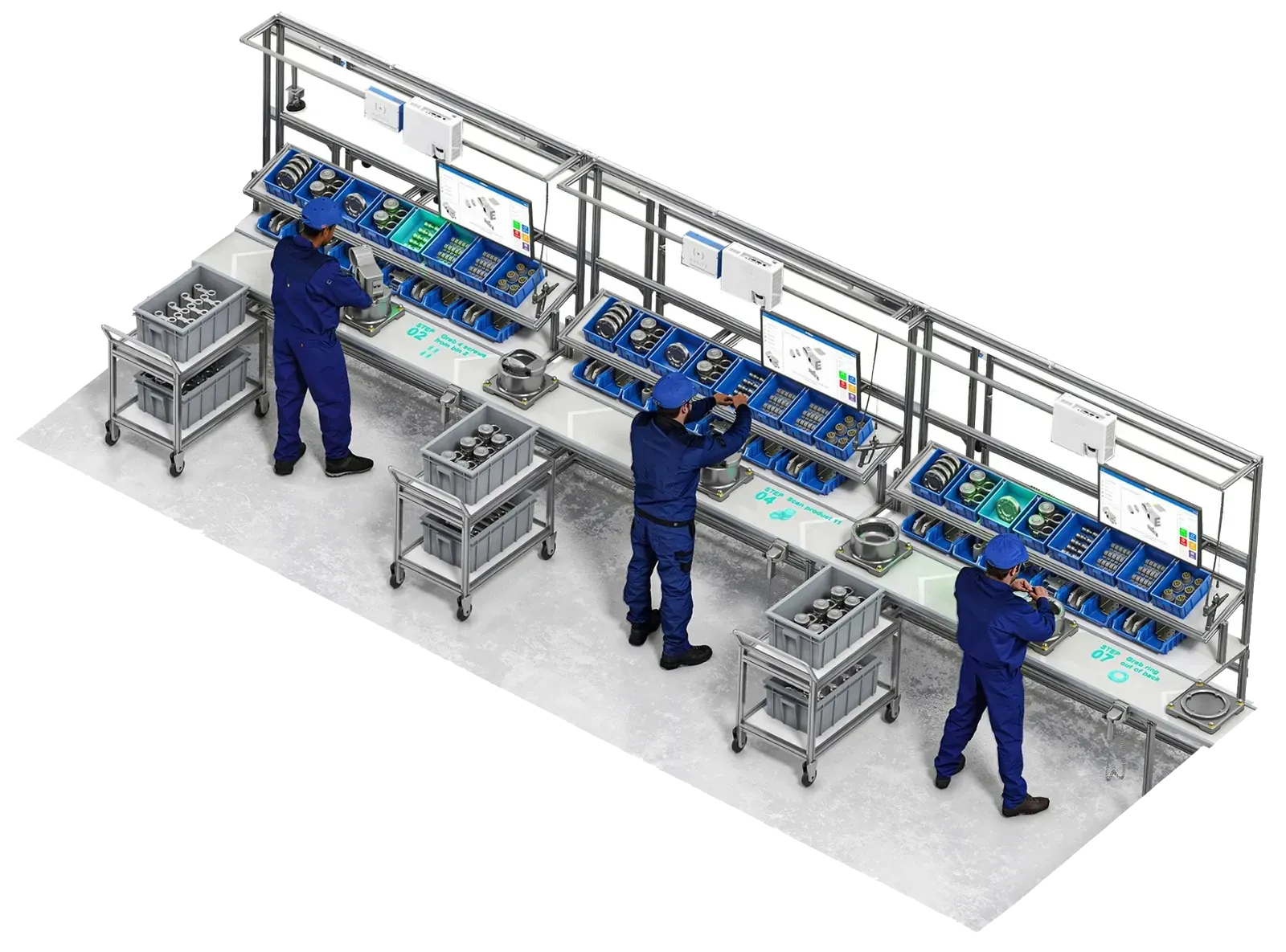
Arkite projects instructions directly onto the workstation, the parts and the product. Operators keep their eyes on the work and their hands free, without wearing a device or looking at a separate screen. Instructions adapt to the operator's experience level and language after a badge scan: novices receive more guidance, experienced operators see only what they need. This is how Arkite responds to the structural skills gap: knowledge lives in the process, and new operators learn at the real workstation. Read more about operator onboarding.
Validation, not only instruction
Where other approaches show what to do, Arkite also checks that it was done. 3D sensors detect picks, placements and hand movements in real time, and the job only moves on when a step is completed correctly. Errors are caught at the moment they happen, not at end of line or at the customer. Read more about error reduction.
One platform, three levels of maturity
Arkite grows with the requirements of each process. Arkite GUIDE provides digital work instructions with AR projection. Arkite VALIDATE adds real-time 3D operator validation. Arkite VISION adds in-process product inspection. All three run on the same software core, can be combined in one plant and use the same jobs and data. A manufacturer never has to replace one system with another to reach the next level. See the three levels.
Built for high-mix production
Jobs and variants reach the workstation automatically, triggered by an MES, an ERP system, a PLC, a database, a barcode scan or by Arkite itself. Plants with and without an MES use the same logic. Variant management in the no-code workflow engine shows each operator only the steps that apply to the unit in front of them. More on variant control.
The whole manual flow on one system
The same platform guides operators in picking and kitting, using projection or DMX lights with 3D sensor validation per action, in assembly and sub-assembly, cabling and wiring, tightening with connected smart tools, inspection and packaging. Engineers build every job in one environment, and every workstation reports to one central server. Explore the applications.
Manual work becomes production data
Every Arkite workstation records cycle times, takt times, step durations, errors, torque values and traceability per unit, and feeds this back to the central Arkite server. The data can be exported to Power BI or other BI tools, giving operations, quality and engineering the same insight into manual work that they already have for automated processes. See production intelligence and traceability.
AI with engineers in control
Arkite AI supports the people who build processes. AI job generation creates a structured starting point in the no-code editor, and the engineer remains responsible for the job that reaches the workstation. AI translation converts instructions from the default language. Both are optional and run through the manufacturer's own AI provider, switched off until enabled. AI detections in Arkite VISION run locally on the workstation, without an internet connection. Learn more about Arkite AI.
Infrastructure that IT can support
Arkite runs on a central server on-premises or in a private cloud, with distributed workstation clients, role-based access and change logging. All project and production data stays with the manufacturer. Open integrations, including OPC UA, MQTT, REST API, Open Protocol, Modbus, S7 and SQL databases, connect Arkite to the systems a plant already runs. Arkite does not replace those systems: it connects them to the operator. See integrations and security.
From one workstation to every plant
Arkite is designed to scale: from a pilot workstation to a production line, a multi-line rollout, an entire plant and multi-plant standardization. Jobs created once can be deployed to every relevant workstation, which makes Arkite a strong fit for manufacturers ramping up new or regionalized plants. Arkite is sold and delivered worldwide, directly and through a network of certified partners. Read about enterprise deployment.
How the trends and Arkite connect
| Market trend | What manufacturers need | How Arkite delivers it |
|---|---|---|
| Structural skills gap | Fast onboarding, knowledge retention | Projected guidance adapted to experience level and language |
| High-mix, low-volume | Right job and variant, every time | Automatic job selection and variant logic |
| Regionalized supply chains | Transferable standard work | Central server, jobs deployed across lines and plants |
| Traceability requirements | Proof per unit | Structured data per unit, including torque values and errors |
| Human-centric manufacturing | Support without extra burden | Hands-free projection, no wearables, real-time feedback |
| AI on the shop floor | Faster engineering, local control | Optional AI job generation and translation, local AI detection |
| Platforms over point solutions | One scalable, integrated system | One software core, three maturity levels, open integrations |
Questions to ask before your next investment
Whatever approach you are considering, these questions help to separate a local fix from a long-term foundation:
- Does the system only show instructions, or does it also verify that each step was performed correctly?
- Does it cover only one process, such as picking, or the full manual flow from kitting to packaging?
- How does the right job and variant reach the workstation, with or without an MES?
- What data does it record per unit, and can that data be used in your existing BI tools?
- Can operators work hands free without wearing or charging a device?
- Where is your data stored, and who controls the use of AI?
- Can the same setup be rolled out to another line or plant without starting over?
Arkite answers each of these on one platform. That is why manufacturers who want to make manual operations as controlled, measurable and scalable as their automated processes choose Arkite as their standard.
Frequently asked questions
What is operator guidance?
Operator guidance is the digital layer that tells operators at manual workstations how to perform each task, step by step, and in its more advanced forms validates that each step was carried out correctly. It replaces paper instructions and static documents with guidance that adapts to the product, the variant and the operator.
How is an operator guidance platform different from digital work instructions?
Digital work instructions show what to do. An operator guidance platform such as Arkite also validates execution in real time, inspects the product during the process, integrates with MES, ERP and PLC systems and records structured data per unit.
Why does Arkite use projection instead of AR glasses?
Projection places instructions directly on the workstation and the product, so every operator sees them without wearing, charging or sharing a device. It works over a full shift, with safety glasses and for every operator at the station.
Do you need an MES to use Arkite?
No. Jobs can come from an MES, but also from an ERP system, a PLC, a database, a barcode scan or from Arkite itself. Plants can start with Arkite and connect to an MES later.
Does Arkite AI send production data to the cloud?
Production and project data stay on the manufacturer's own Arkite server. AI job generation and translation are optional and use the manufacturer's own AI provider. Arkite VISION AI detections run locally on the workstation.
Prepare your manual operations for what comes next
The trends in manual manufacturing all point in the same direction: operators need better support, manufacturers need more control and data, and isolated tools are giving way to platforms. Arkite brings guidance, validation, inspection, integration and data together in one platform built for manual work. Book a demo to see how Arkite fits your processes, or read more about how Arkite works.